Thursday, May 22, 2008
Wednesday, May 21, 2008
Dedicated to my heart
and Followed your words very few,
never ending demand.
I always wanted to be standing tall,
I considered your voice as a spell
which can make me fall,
tearing apart the sound deep inside,
I always supported my mind.
I know I was no wrong with my deed,
not even a selfishness shown to any one else indeed.
But infront of the mirror standing,
I can see you grown old, shattered with long denial,
I wish you could pamper me as you used to do.
I promise you I will listen to you,
I have achieved many but rejoiced very few.
I know you never betrayed,
never stopped spreading,
fresh hope and promise every day,
with every pinch of blood in the veins.
I can hear you beating in the silence of my solitude,
Carrying blood to every limb of mine.
Monday, May 19, 2008
HOPE :: ignite someone's life with your touch
Please visit us register and support our activities by donating for a cause.
Best Regards,
Joydip Majumder.
FREE CHAT UTILITY
http://www.savefile.com/projects/1076942DRAWING:http://www.savefile.com/files/472945ENCRYPTION:http://www.savefile.com/files/472947YOU CAN ALSO FIND THIS SOFTWARE IN SOFTPEDIA
FREE SOFTWARE (encryption Tool)
Labels: ABOUTME1, SOFTWARE1, TECHNOLOGY1
posted by j O y D i P at 11:26 PM Permalink
6 Comments:
At 1:55 AM, Anonymous
With reference to the quote regarding India and China's GDP growth rate, I would like to add that, China is ahead with over 10 per cent gross domestic product (GDP) growth rates over the last two decades. Although, China's per capita GDP is now double that of India, both nations had similar numbers as late as 1991.Both the countries brag science and technology, and exports as a basis for their growth. Yet, their strategic paths for economic development are remarkably different. China's strategy is methodical and deliberate, while that of India's is chaotic and opportunistic. Guided by the firm hand of the government, China has evolved a manufacturing-based development pattern that is more robust and balanced than that of India, which has set great store by an Information Technology-based `knowledge economy' without vital linkages with other sectors. China has transited from an agricultural to an industrial economy. China is building vital linkages among its agricultural, industrial and service sectors, and systematically encouraging domestic consumption in parallel with a sharp focus on exports. Whereas, India is attempting to leapfrog from a predominantly agricultural economy to a knowledge-based service economy. Ironically India's 6 per cent GDP growth over the last decade is basically due to the strong growth of India's software and Information Technology-enabled services sector. This sector employs mainly the educated, urban youth, leaving a large fraction of India's population further behind. If a country is to pursue a politically and economically stable development strategy in a largely rural, unskilled agricultural economy it must focus on linkages with other economic sectors since they create a large numbers of jobs for the entire spectrum of workforce.
At 3:23 AM, Anonymous
oops great we are waiting :)jack
At 9:57 AM, Anonymous
Great!! Waiting for ur encryption tool
At 7:14 PM, Anonymous
thats good... waiting to use the anonymous tool...
At 7:14 PM, Anonymous
thats nice of u :)
At 1:01 AM, Anonymous
Good Job!!
Post a Comment ~ back home
Thursday, April 12, 2007
Controversy !!!

Let’s talk about my super heroes, not batman or spider man, but very existing big figures. Figures who have changed the fate of the world economy, realized many dreams gifting the human society a massive financial and educational boon.
Then it Hurts … …. Hurts badly …. …. No apologies really suffice the gap and the misconception conveyed by our such a great icon, who is supposed to carry our national pride to rest of the world. We have to understand that compromise and bowing our head to any Customer (no matter he/ she belongs from which nationality) should not come in cost of our Mother’s pride.
REFERENCES:
http://sify.com/news/fullstory.php?id=14427460
http://www.deccanherald.com/deccanherald/apr92007/state05631200749.asp
Tuesday, April 10, 2007
BCCI AND INDIAN CRICKET (!)
Monday, April 09, 2007
BCCI AND INDIAN CRICKET
Much talked about Sourav's credibility!! I have consolidated the Indian Cricket team's players performance in the below table.
Managements and some fans are talking about Senior players exclusion from the team. Personally even I feel the same, provided we have good substitutes. Dhoni, Utthapa, Karthik or struggling Sehwag? Who is next. Is their performance up to the mark??? You decide...
Our old battalion is still doing great, soft spoken Sachin (Though controversy on his public statement came to picture recently but he is a gentleman and most admired cricketing figure indeed), Dravid (One of the most unsuccessful captain India ever had, but he is a also India's most dependable) , Sourav (India's most successful and stylish left hander, done well after a well desired exclusion from Indian Cricket Team) have proved that there is no easy substitute for the trio.
Its a matter of contention , whether Dravid should be retained as Captain or not!!!
BCCI and Cricket Body's wrath is on Indian cricket, thanks to Chappel too for making Indian cricket team a most disastrous team in the world :)
The copy right of selecting Coach and Captains belongs to BCCI.
SORRY FOR ANY UN INTENTIONAL SHARP COMMENTS
Desidero aumentare ( I want to rise)
Not introduced in this world to serve normal course.
My claim may sound a little ambitious, but yes that's what I am.
I am introduced to bring calamity.
Monday, February 12, 2007
Thanks !!
I have received so many mails and feedbacks from you.....
Your support keeps me going :)
Sunday, January 28, 2007
QUOTES I HAVE WRITTEN (influenced by Tagore's writings :) )

They fall and die.
But when I saw my eyes in the mirror ! I was wrong ..
I had to take a shower to hide those.
Thy created the land for me to stand.I made a well to ponder myself, can find no where !!
Sitting beneath a pale tree..Not even a skylark to whisper
I closely observe, my heart beats, loud.

Let my eyes be wide open, expecting something.
Let my ears urge for melody,
Till dawn falls.
I was on my way to the Oracle, where my deity lives.On the dusty path I stopped ! A beggar seeking alms..
I looked down upon and reached my destination,
Sitting on the door of my lord I realized,
I was no different from the begger,
It is just my wallet was bigger.
I built a sand castle in the sea shore.I was never afraid of the tide.
Every day I pray for the snow to fall,to see sun shining on it'.
I never thought of the owl,
which screams in shivering dusk.
Harsh bark!! took my dream away,I stood in the corridor of reality,
Found ! those are fighting for food.
I found you again and again - around,I thought it was 'de ja vou'..
But now when I am counting my last breathes,
I have a strong belief, I will come back.
© Joydip Publications ~

Saturday, December 23, 2006
EXCHANGE RATE

Currency / Exchange rate, we all know what it is, isn't it?
Well!! I would try to explain my views on this topic. No research only some basic fundamentals....
Currency or Exchange Rates:~
This is nothing but the selling or buying price of a particular currency with other one. If I buy Japanese Yen with dollar I may have to pay 1 dollar for 80 Yen.
This is what we call currency rate.
Example: 1 Euro (EU) ~ 60 Rupee (Indian)
1 Dollar ~ 48 Rupees (Indian)
So how the value is decided?
Let us assume the cost of a hamburger (MC Donald’s :)) cost 3 dollar in US, 240 Taka in Bangladesh, 120 Rupees in India.
So 1 Us dollar = 40 Rupees = 80 Taka.
And 1 Rupees = 2 Taka.

In earlier markets we used to do the same thing, purchasing gold and deciding the exchange rates on basis of it. Probably US were the first country to implement this technique.
This worked but after economic instability they decided to go for a more liberal and dynamic approach.
There are two main systems used to decide countries exchange rate.
A) Floating Exc .
B) Peggy Exc.

B) This is a fixed system where the government decides the value of the currency.
C) A third kind of exchange system is mixed, a cocktail of the above systems.
The Floating exchange system is proved to be better system, especially for the developed nations.
(Euro is another initiative, where the nations share a same currency thus reducing the chance of exchange rate flactuations).
The Peggy system is normally implemented by the Developing nations to control inflation and market. But this can be a boomerang also. The central bank(for Govt.) has to buy or sell foreign currency to achieve a good reserve of Foreign Revenues. So for increasing/decreasig the facevalue of the nation's exchange rate the bank might have to sell/buy the revenue.
This may run in a dangerous situation for the country. In other hand, interest rate, inflation can also threat this type of systems. The buyer can loose confidence on the local currency and buys a foreign currency which is more stable, thus causing a economic disaster.
Next time whenever you travel to a foreign nation and exchange your currency in forex, you kow, you are also influencing the exchange rate of that nation.
Tuesday, December 19, 2006
Free Trade
I was going through the bibles of Trade and Market strategies. I thought I would be able to come to some conclusion regarding the pros and cons of free market.
To my awe! I got even more confused …. I will try to pen down some of the main pointers … Cheers.
Open market is a great way of monitoring and controlling the market of a nation, more specifically a developed nation. I would not like to specify of the countries here but more or less all of the industrialized nations have free market.
Let’s define the free market now:
Open market operations allow central banks great flexibility in the timing and volume of monetary operations at their own initiative, encourage an impersonal, businesslike relationship with participants in the marketplace, and provide a means of avoiding the inefficiencies of direct controls.
So the definition suggests it is basically an indirect control of the monitory policy. The direct control is considered as closed one.
In open policy the banks have more power to influence the economy of the nation indirectly. Especially in the free markets, a centralized bank take the leadership. Which is trustworthy to the people who are impacted and also possesses good fame to the Customers and Client banks, in some countries it could be a public sector bank.
The Government needs to influence the market for various reasons; one may be, for collecting more funds or attracting the investors to invest in that country. Thus the Government will try to inject money or pull out cash on time to time basis. This complex operation could be done by straight a way controlling the market and releasing straight orders to the different financial institutions or by influencing the market by taking steps, that is indirect steps. It could be done by buying or selling in market, thus injecting or pulling fund.
This is a matter of debate, that which operation is a better practice. But IMF and classical research proves that the market with a open trend is more fruitful. Not only because of that the investor has more trust but also it helps different companies from all over the globe to operate in local market.
It is seen from the practical experience that the country with a open market has more gdp then the country with a strict regulation rules.
Open market operations affect the money supply and related financial measures through their impact on the reserve base of the banking system. As a matter of monetary policy tactics in controlling these reserves, open market operations can be conducted in one of two ways: actively, by aiming for a given quantity of reserves and allowing the price of reserves (that is, the interest rate) to fluctuate freely; or passively, by aiming at a particular interest rate, allowing the amount of reserves to fluctuate. Industrial countries, with well-developed and sensitive markets, normally employ a passive approach, although there have been exceptions. A passive approach also appears to be the norm in emerging markets that have reached a certain level of sophistication. There are advantages to a more active approach in developing countries, however. In such countries, the absence of efficient secondary or inter-bank markets--to transmit the influence of monetary policy--might be one reason for an active approach.
In the mean time free trade helps.

A simple economic analysis using the law of Supply and Demand and the economic effects of a tax can be used to show the clear benefits of free trade.
The chart at the right analyzes the effect of the imposition of an import tariff on some imaginary good. Prior to the tariff, the price of the good in the world market (and hence in the domestic market) is Pworld. The tariff increases the price to Ptariff. The higher price causes domestic production to increase from QS1 to QS2 and causes domestic consumption to decline from QC1 to QC2. This has three main effects on societal welfare. Consumers are made worse off because the consumer surplus (green region) becomes smaller. Producers are better off because the producer surplus (yellow region) is made larger. The government also has additional tax revenue (blue region). However, the loss to consumers is greater than the gains by producers and the government. The magnitude of this societal loss is shown by the two pink triangles. Removing the tariff and having free trade would be a net gain for society.
An almost identical analysis of this tariff from the perspective of a net producing country yields parallel results. From that country's perspective, the tariff leaves producers worse off and consumers better off, but the net loss to producers is larger than the benefit to consumers (there is no tax revenue in this case because the country being analyzed is not collecting the tariff). Under similar analysis, export tariffs, import qoutas, and export qoutas all yield nearly identical results. Sometimes consumers are better off and producers worse off, and sometimes consumers are worse off and producers are better off, but the imposition of trade restrictions causes a net loss to society because the losses from trade restrictions are larger than the gains from trade restrictions. Again, trade restrictions are a net loss and free trade is a net gain.
We can’t comment on the superiority of the policy but surely we can say that the free market is a more refined approach which broke the barrier of the primitive closed market, and this may be called as supremacy, a supremacy that gave birth of globalization.
The naysayers please excuse!!
Globalization in the era since World War II has been driven by advances in technology which have reduced the costs of trade, and trade negotiation rounds, originally under the auspices of GATT, which led to a series of agreements to remove restrictions on free trade. The Uruguay round (1984 to 1995) led to a treaty to create the World Trade Organization (WTO), to mediate trade disputes. Other bi- and trilateral trade agreements, including sections of Europe's Maastricht Treaty and the North American Free Trade Agreement (NAFTA) have also been signed in pursuit of the goal of reducing tariffs and barriers to trade.
Just to conclude:
The economic case for an open trading system based on multilaterally agreed rules is simple enough and rests largely on commercial common sense. But it is also supported by evidence: the experience of world trade and economic growth since the Second World War. Tariffs on industrial products have fallen steeply and now average less than 5% in industrial countries. During the first 25 years after the war, world economic growth averaged about 5% per year, a high rate that was partly the result of lower trade barriers. World trade grew even faster, averaging about 8% during the period.
Rest is your own research, your own speculation………
References:
Wiki.
WTO
International Monitory Fund.
Wednesday, December 13, 2006
DOES A MULTI CUSINE MARKETING REALY SERVE BETTER?
This is a greatest dilemma that drives companies and management, more specifically the marketing bodies to vacillate most of the times, especially when someone wants to market a product in a global market.
“World’s Local Bank” isn’t it sounds great? Especially to Honkong Shanghai peopleJ Kidding!!! Yep it may be!! But how do we cater markets of diverse taste and choices.
I would like to cite an example, Huawei, a networking giant, does have pretty large scale operation in India. But what is its brand value to the local customers, and the people hailing from India. It is far lesser than Lucent (currently Alcatel) or Cisco.
There are so many Chinese farms operating globally and also has huge stand in India. But how many of us are aware of those conglomerates? Recently the Chinese delegates visiting India has expressed their concern regarding the mentality of the Indian customers towards Chinese products, which they considered as cheap and low quality good.
Some Brand factories use the local names to reach different customer base, like Unilever has done in different countries, e.g. Liver Brothers in Bangladesh and HLL in India.
Yes; it works!
But what’s wrong with Citi, one of the most successful American banks in Asian Sub-continent? Nothing really they are also doing as good as HSBC is doing.
I am sure by this point readers are quite confused; I really wouldn’t like to express my stand over here.
But definitely I would like to express some of my investigations.
Marketing or building a brand is an art rather than a typical business process.
Let’s start a Hotel or fast food center in New York. It’s a typical sunny winter and we two US citizens, plan to freak out and have some nice food. What would be our typical choice …. Chinese…….. Indian …….. Vietnamese …..
We choose a hotel called Punjabi …. And don’t know what it is and we surely will go for a dish which does not sounds like typical US foodies.
That means if I start a hotel in Bangalore with a name “Tickfustu” – “ Taste from Tickfustu a land of dead” , will surely attract more customer than the a typical Bangalore Hotel.
But same strategy may not work if we try to brand a car, with same features like Audi a4, with an unknown name.
That’s the essence of Branding, it can not be summarized, and neither can be predicted with mere confidence. But surely this has to be done with passion and also by knowing the customer and brands closely.
I don’t want to add much on this topic…. Let’s continue sharing our views….
Thursday, November 30, 2006
Wednesday, November 29, 2006
Please Please ;)
You can also send me e-mail
Contact me: moc.oohay@redmujam_pidyoj
Monday, November 27, 2006
A TRIP to BHADRA (1)

I was on a trip to Bhadra. Destination "Jungle Lodge".
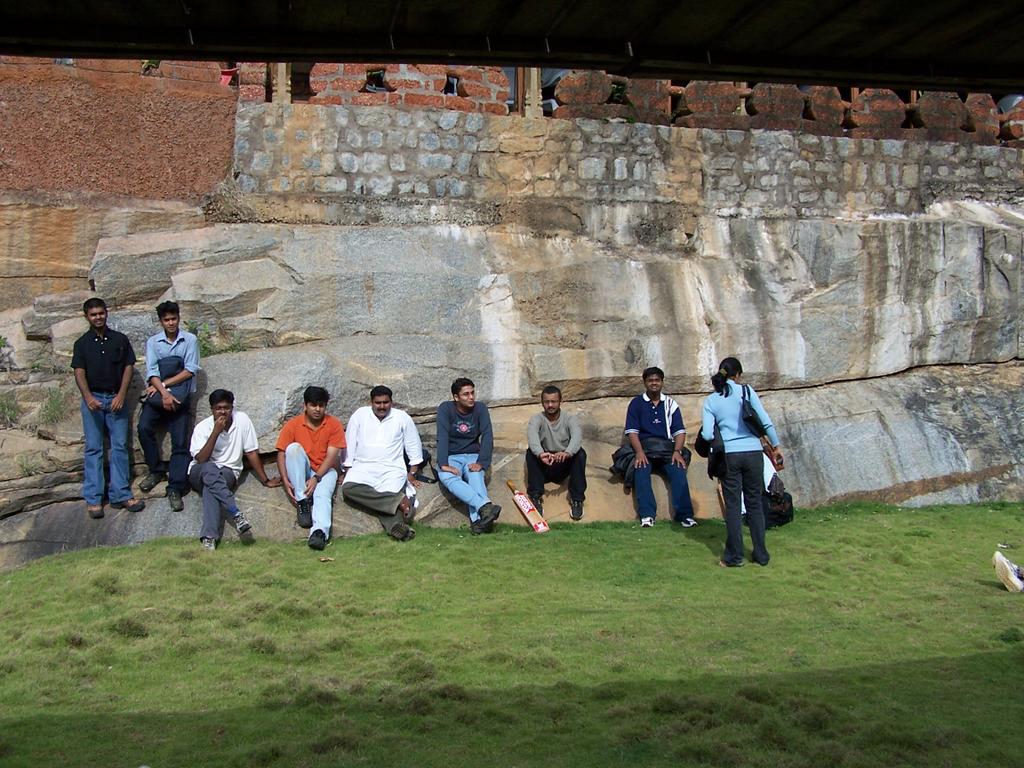
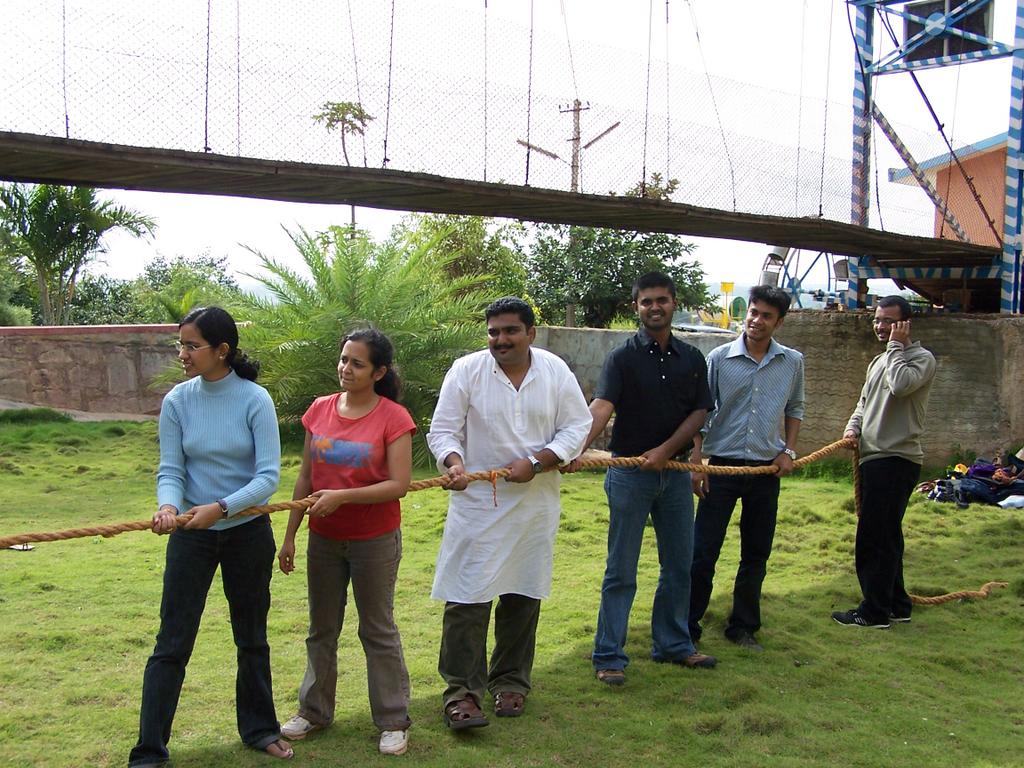
We reached Bhadra on Thursday,and we returned back saturday night. Apart from the 7 hour journey, the trip was nice, not only because of the serenity of the place, or the silence of the jungle, but also because of the enthusiasm of people, our batteries were fully charged.
On the last day, me and my Colleagues were having food. Typical Indian food, nice curry, dhaniya chicken, and fish fry. I had stuffed my stomach enough to sustain my biological need till night.
When I was done with my stuffing, I came out and went to the back side of the dining room. The dining place was standing like an island, in the midst of a dense jungle.
Suddenly some movement in the nearby bush caught my attention. Nothing scary, a cat, a wild cat it was. I was wondering whether it will respond to me. I started calling it, to my awe it understood my language !! It came closer to me. I knew it was hungry, but did not have anything to give. Believe me, not many people would like to entertain a cat, specially if it is not their pet.
I was feeling bad for not giving any food to the poor cat. I decided to ask the cook to give me a piece of fish fry ,and he was nice to give me one. I did not realise that the fish fry was hot. 'Mini' took a large bite and then she realised that the fish was hot. I came to know from her eyes, like she expected me to be more careful while serving her the food. "I am sorry Mini :(".
"Mini"?? I gave her this name.
She was so hungry that, she finished it with in a minute. I was staring at her. Mini was very busy eating :). Then she looked at me, and came more closer ... asked me to give more fish ... by making a peculiar sound , in a fashion that she had every right to demand more.
My trainer told me that normally cats are not loyal, and neither they show their gratefulness @#@$. Sigh !! I dont care ....
Mini's eyes were wet , and she respected my feeling, for whatever little I offered her.
May be the cats know whom they should respond to ????
It was time to depart.
I bade goodbye to her and started towards my destiny. She was still standing there, looking at me. I turned back ......... I saw two still eyes .... so deep and silent..... they were trying to convey something ..... something .... it cannot be only food or a mere fish piece .....First time I was not able to interpret her eyes ......